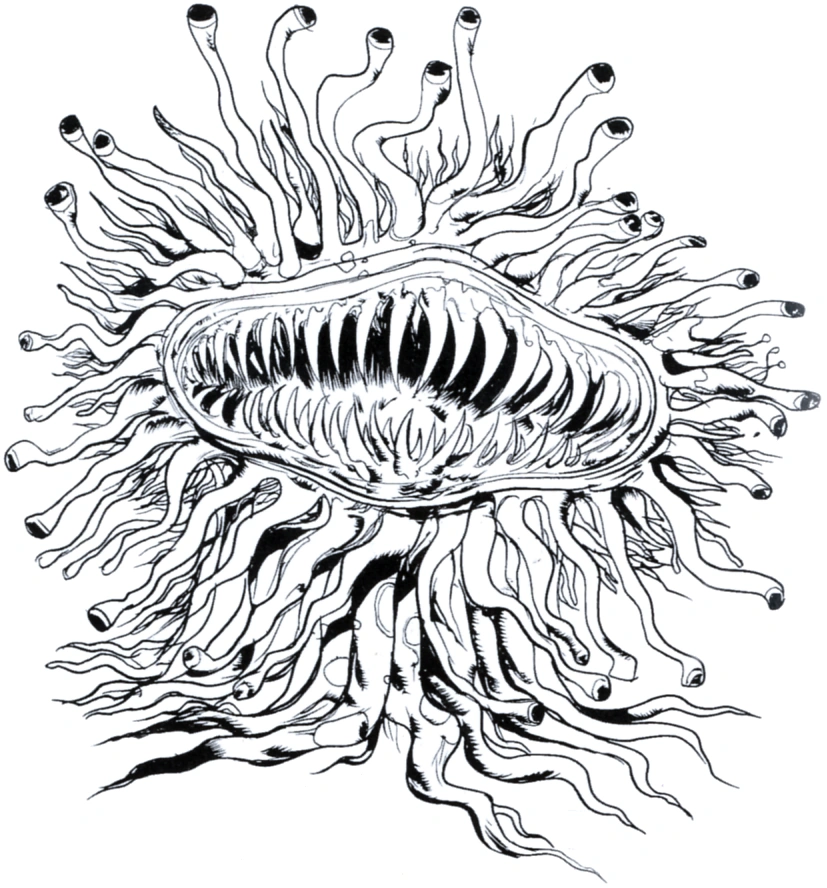
Artwork for Final Fantasy II by Yoshitaka Amano.
The malboro (モルボル, moruboru?), also known as the molbol, morbol or Mad Oscar, is a recurring creature in the Final Fantasy series, debuting in Final Fantasy II. It is a large, green, tentacled plant-like creature with an anemone-like head and large mouth lined with sharp teeth. It is renowned for its dreaded Bad Breath, which can inflict many status effects on its targets, crippling unprotected parties, which can frequently be learned as blue magic. The malboro has ranked among the more iconic and difficult enemies in the series, even appearing as a boss on occasion.
Appearances
Final Fantasy II

The malboro appears as an enemy encountered in the Cave of Mysidia. While it lacks its signature Bad Breath, its regular attacks have a chance to inflict Paralysis, making them dangerous enemies nonetheless. Notably, in the Pixel Remaster release, malboros initially had a 100% chance of inflicting Paralysis with their physical attacks, making them a more serious threat, but this was patched out.
Final Fantasy IV
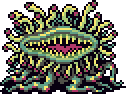
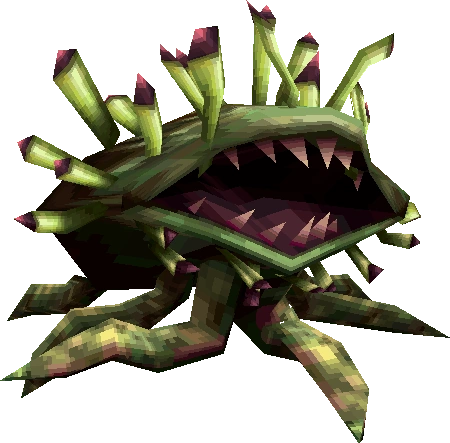
The malboro, also known as the molbol, appears as an enemy encountered in the Sylph Cave and the Lunar Ruins bonus dungeon exclusive to the Advance and Complete Collection releases. Final Fantasy IV marks the debut of its Bad Breath attack, which only affects a single party member. The malboro always uses Bad Breath on its first turn.
Final Fantasy IV: The After Years
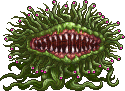
The malboro appears in Kain and Edge's Challenge Dungeons.
Final Fantasy VI
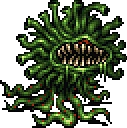
The malboro, also known as the Mad Oscar, appears as an enemy encountered in Darill's Tomb. While it retains its dreaded Bad Breath, it is the only enemy in the tomb incapable of inflicting the Zombie status, making it arguably the least dangerous enemy in the tomb.
Final Fantasy VII
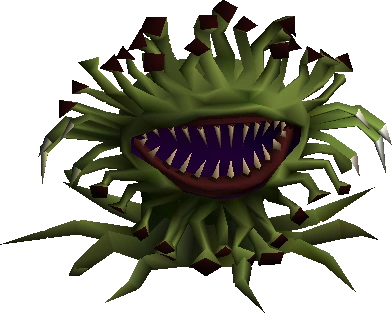
The malboro appears as an enemy encountered in Gaea's Cliff and the Northern Cave. It may also appear in the Gold Saucer as a monster in the Battle Square's seventh round after obtaining the Highwind.
Crisis Core -Final Fantasy VII-
The malboro appears as an enemy encountered in the Banora Underground and during the mission "Underground Caves."
Final Fantasy VII Remake
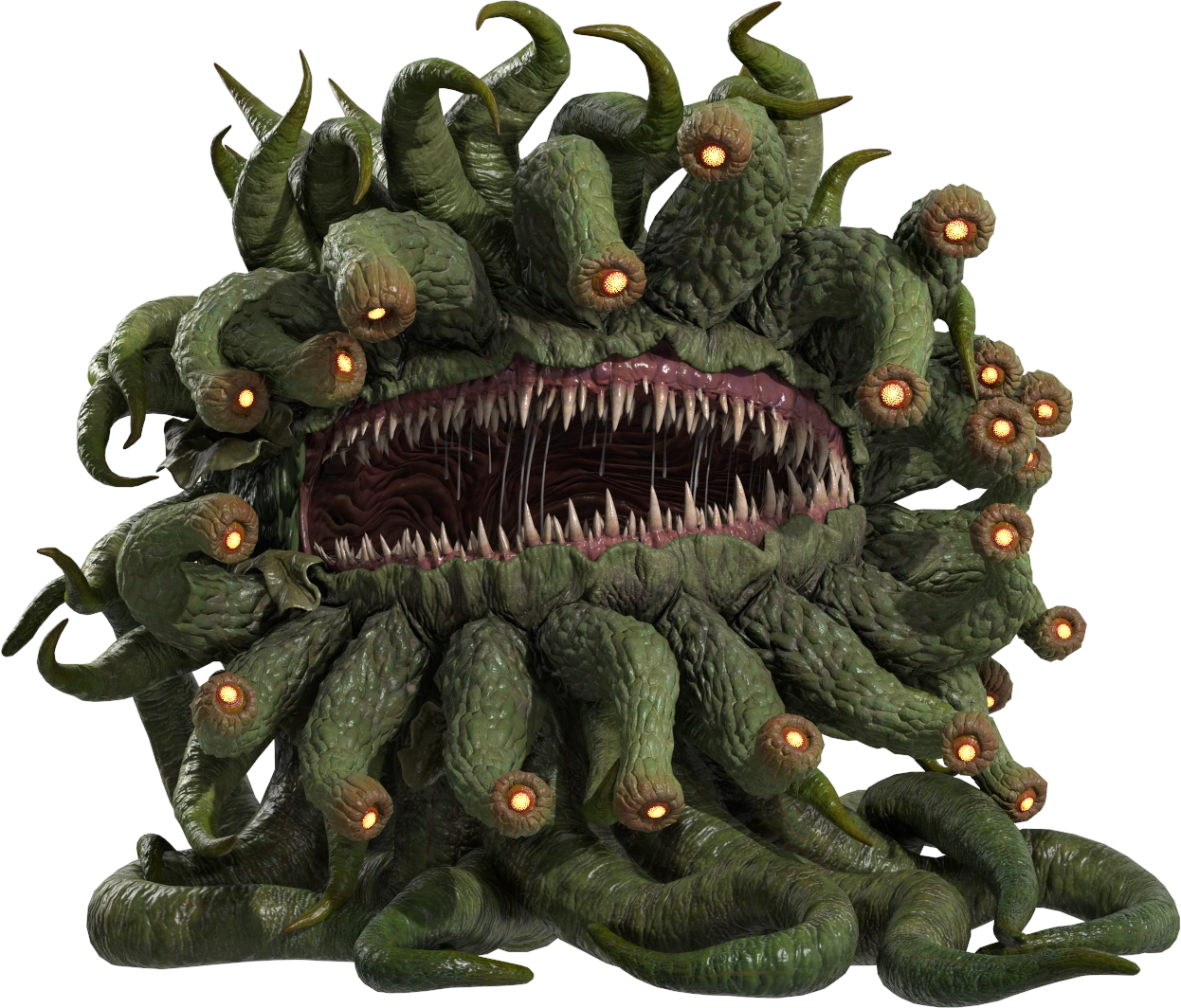
The malboro appears as an optional boss encountered in the Shinra Combat Simulator at the end of the "vs. Monsters of Legend" challenge on hard mode. Defeating the malboro will reward the "That's the Smell" trophy and a  Refocus Materia. The player can also learn the Enemy Skill "Bad Breath" from it.
Final Fantasy VIII
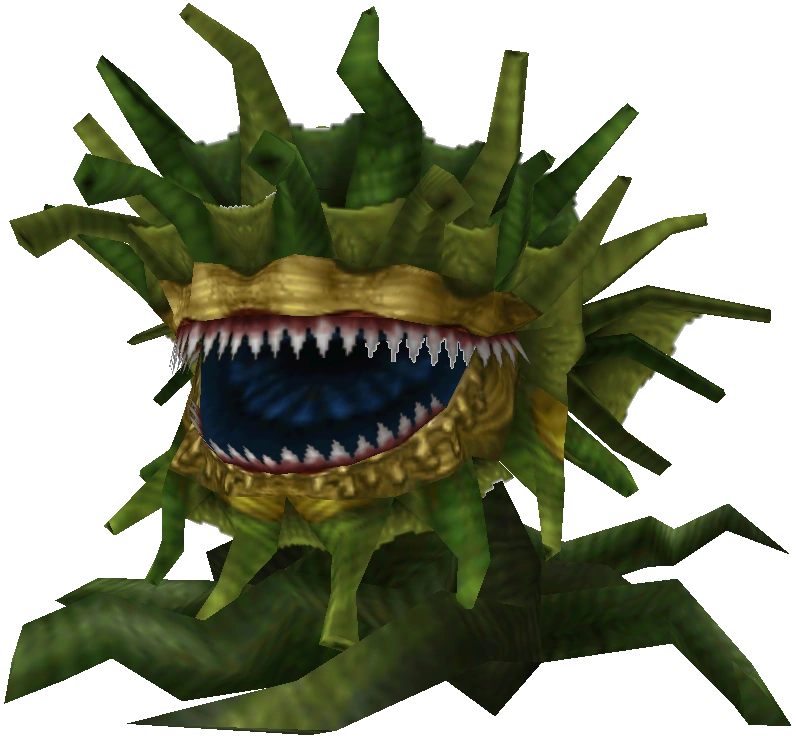
The malboro appears as an enemy on the Island Closest to Heaven, Island Closest to Hell, Grandidi Forest, and Great Plains of Esthar. It almost always uses Bad Breath on its first turn and, thus, the party should be prepared with good status defense junctions. It can drop the malboro tentacle used to teach Quistis Bad Breath as Blue Magic and to craft her ultimate weapon, Save the Queen. The tentacles are also needed to acquire Doomtrain. Malboros can be devoured to boost spirit. The malboro can be obtained as a poison-elemental Triple Triad card with 7/7/4/2 values.
Final Fantasy IX
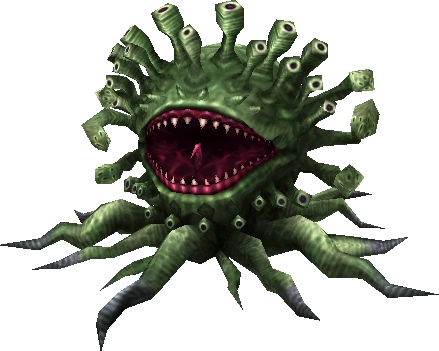
The malboro appears as an enemy first encountered in Pandemonium and, afterwards, on the world map on the Mist Continent. While it starts the battle grounded, it is capable of entering a floating state that renders it immune to earth-elemental attack, but vulnerable in turn to wind. It is not as threatening as other appearances, partly because its Bad Breath only hits one character.
Final Fantasy X
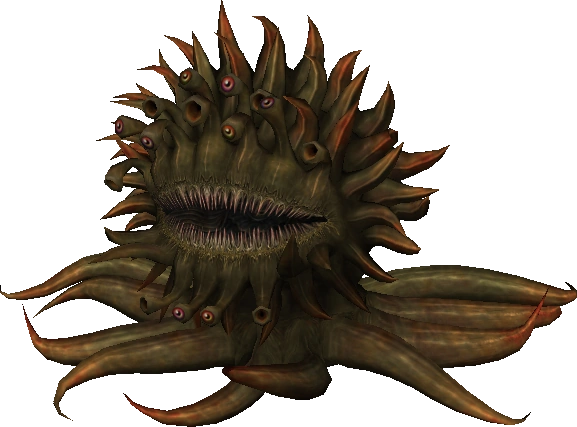
The malboro appears as an enemy encountered in the Calm Lands and the Cavern of the Stolen Fayth. While weak against fire, it will use Bad Breath more frequently when hit by fire-elemental attacks. It may drop a variety of status-inflicting weapons or status-warding armors upon defeat.
Final Fantasy X-2
The malboro returns as an enemy encountered in Besaid, the Thunder Plains, the Bevelle Underground, and Via Infinito.
Final Fantasy X-2: Last Mission
 This section about an enemy in Final Fantasy X-2: Last Mission is empty or needs to be expanded. You can help the Final Fantasy Wiki by expanding it.
Final Fantasy XI
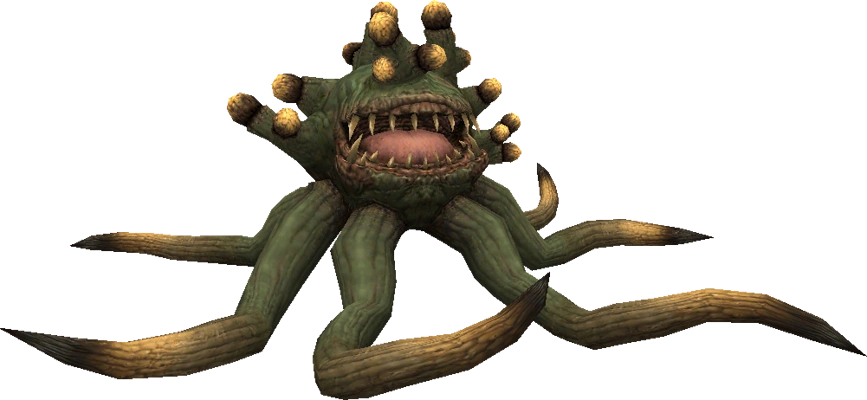
The morbol appears as a family of plantoid enemies, with the common morbol encountered in Davoi and La Vaule (S). In addition, a variant of morbol known as the malboro can be encountered in the Pashhow Marshlands. Aside from this enemy and the malboro vine and fiber items, the morbol name is used for the rest of the family.
Final Fantasy XII
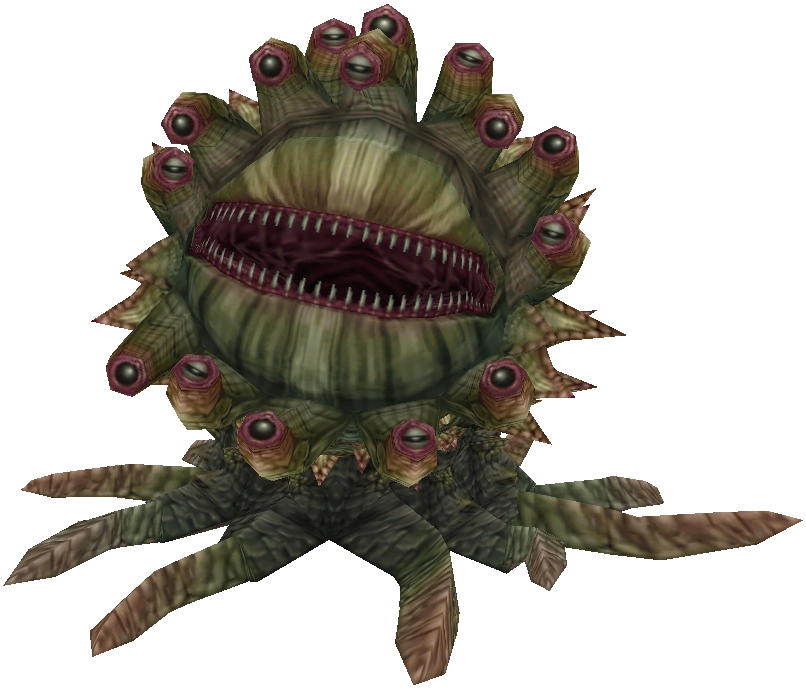
The malboro appears as a genus of enemies, with the common malboro being encountered in the Golmore Jungle and the Lhusu Mines. Malboro-type enemies are fairly small, usually only human height. Malboros walk with their mouths facing upwards when not in battle—they tilt their mouths down to attack when they engage the party. They may use Cloying Breath in addition to Bad Breath.
Final Fantasy XII: Revenant Wings

The malboro appears as a rank II non-elemental melee Esper.
Fortress
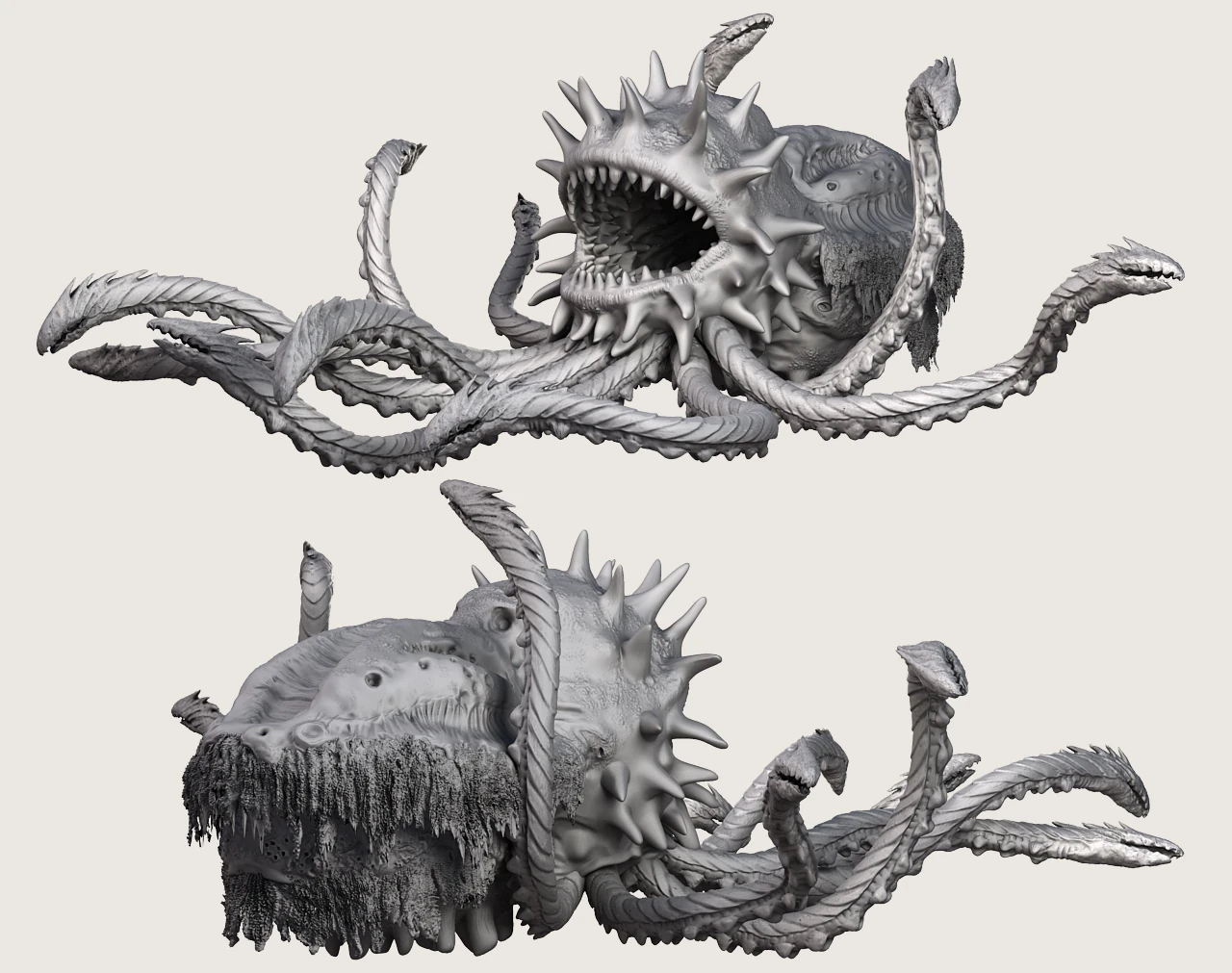
The malboro was set to appear as a boss with smaller mouths on the inside of its mouth in place of teeth and on its long tentacles. It was gigantic in size, as large as the titular fortress.
Final Fantasy XIV
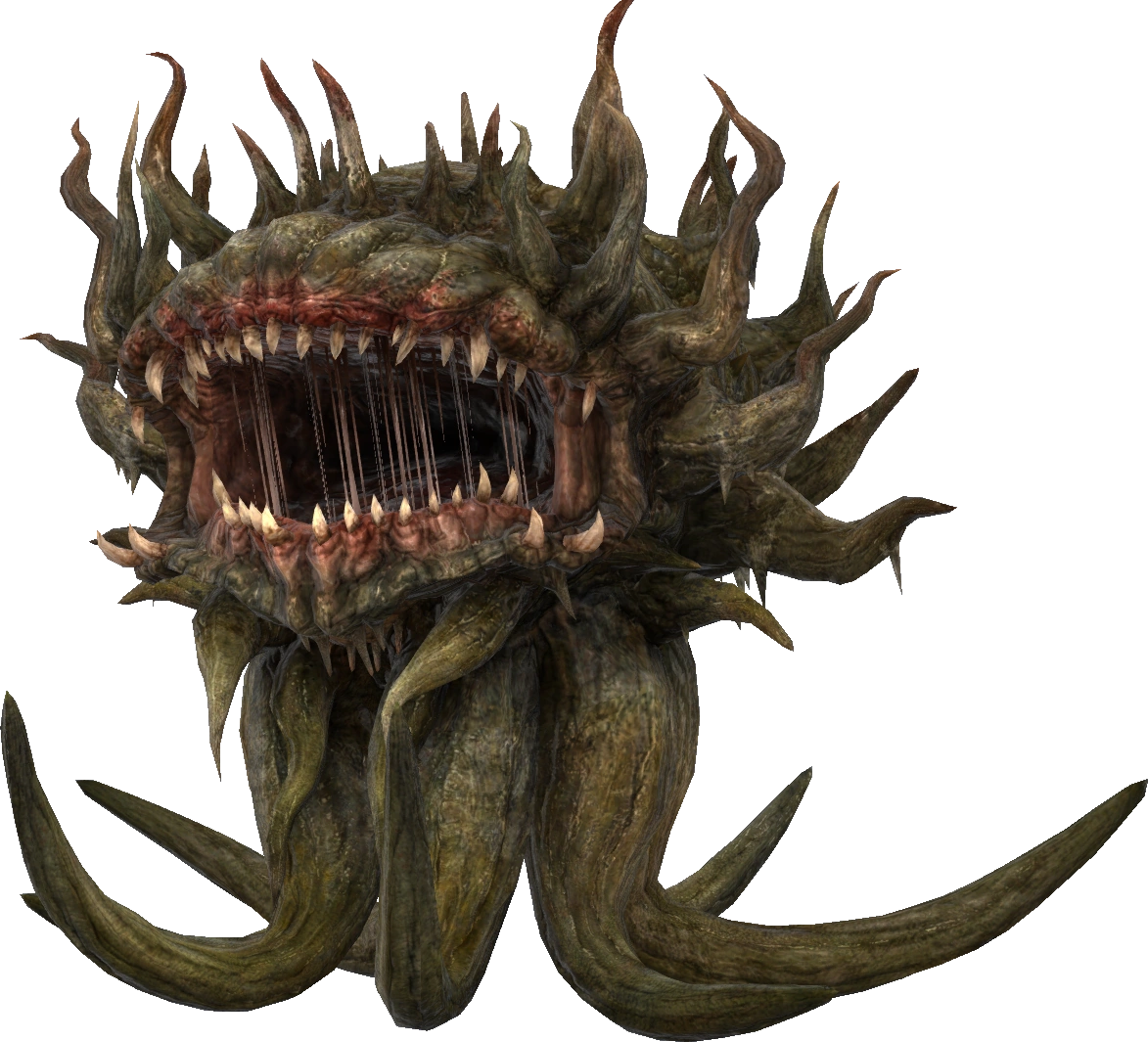
The morbol appears as a family of seedkin found throughout the world, with the common morbol being encountered in the Larkscall region of the East Shroud and the Fogfens region of Mor Dhona. Its signature Bad Breath targets players in a wide-reaching fan, requiring swift maneuvering to avoid its crippling effects.
Players can obtain a morbol mount by obtaining the True Blue achievement, which requires completing the final raids of each wing of the Bahamut and Alexander (Savage) raids while synced with no Echo, using a party composed entirely of blue mages. It is considered one of the most difficult mounts to obtain.
Final Fantasy XV
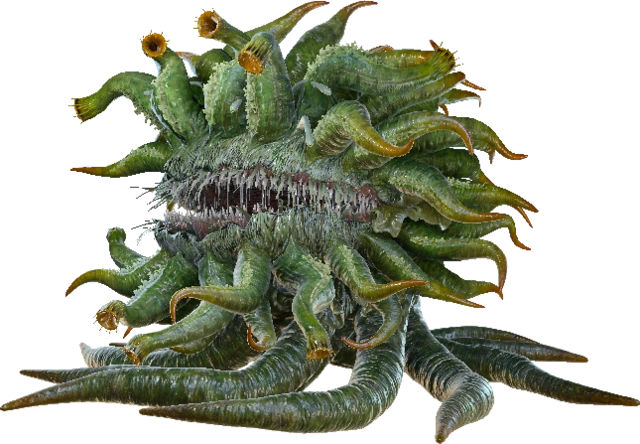
The malboro appears as a boss encountered in Fodina Caestino. It can later be encountered during the "No Stopping the Great Stink" hunt, in the Costlemark Tower Menace dungeon, and during a timed quest. It appears in swampy areas and ambushes the party. The Stinker: Malboro is a lure fashioned after a malboro and suited to catching Vesper Gar and Snakeheads.
A King's Tale: Final Fantasy XV
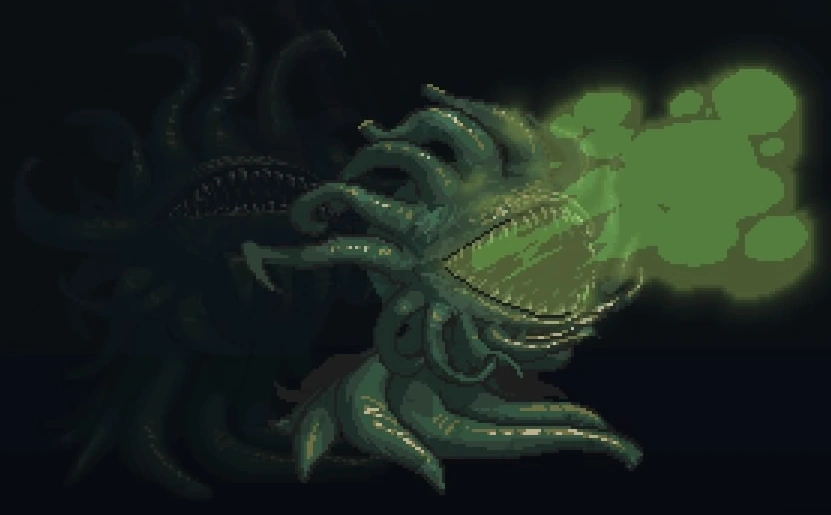 This section about an enemy in A King's Tale: Final Fantasy XV is empty or needs to be expanded. You can help the Final Fantasy Wiki by expanding it.
Justice Monsters Five

 This section about an enemy in Justice Monsters Five is empty or needs to be expanded. You can help the Final Fantasy Wiki by expanding it.
Final Fantasy XVI
The morbol appears as the second boss of the game, encountered at the end of the Stillwind stage. Owing to the lack of status effects in Final Fantasy XVI, its Bad Breath inflicts damage instead. The morbol nests beneath piles of refuse in shallow bodies of water, ambushing prey that disturb the pile. After being ambushed by the morbol in Stillwind, Clive is able to recognize future morbol nests that he encounters, preventing them from ambushing him.
Morbol tentacles can be used for medicine against "gout, melancholy, and moon sickness" as per a note found in the second hideaway's garden. After being excised from the trunk and dried in the sun until brittle, the tentacles are ground to dust and mixed with warm coeurl milk.
Final Fantasy Tactics

The malboro appears as the weakest member in its family. It can only use its signature Bad Breath when an ally with the Beastmaster ability is nearby.
Final Fantasy Tactics Advance
 This section about an enemy in Final Fantasy Tactics Advance is empty or needs to be expanded. You can help the Final Fantasy Wiki by expanding it.
Final Fantasy Tactics A2: Grimoire of the Rift
 This section about an enemy in Final Fantasy Tactics A2: Grimoire of the Rift is empty or needs to be expanded. You can help the Final Fantasy Wiki by expanding it.
Crystal Defenders
 This section about an enemy in Crystal Defenders is empty or needs to be expanded. You can help the Final Fantasy Wiki by expanding it.
Final Fantasy Type-0
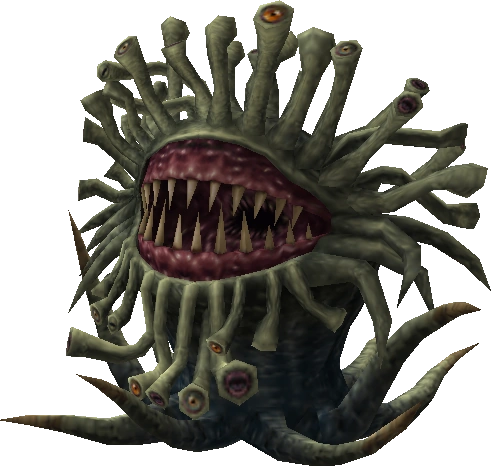
The malboro appears as an enemy encountered in the Eibon Region and Roshana Province.
Final Fantasy Crystal Chronicles
The malboro appears as a boss encountered the Mushroom Forest, casting Blizzard and Slowga as well as using its Bad Breath attack.
Final Fantasy Crystal Chronicles: My Life as a King
The malboro appears as an enemy encountered off-screen in Langooth Peak, Rinfor Nightwood, Beltevra Forest, and Musqu Mazewood.
Final Fantasy Crystal Chronicles: The Crystal Bearers
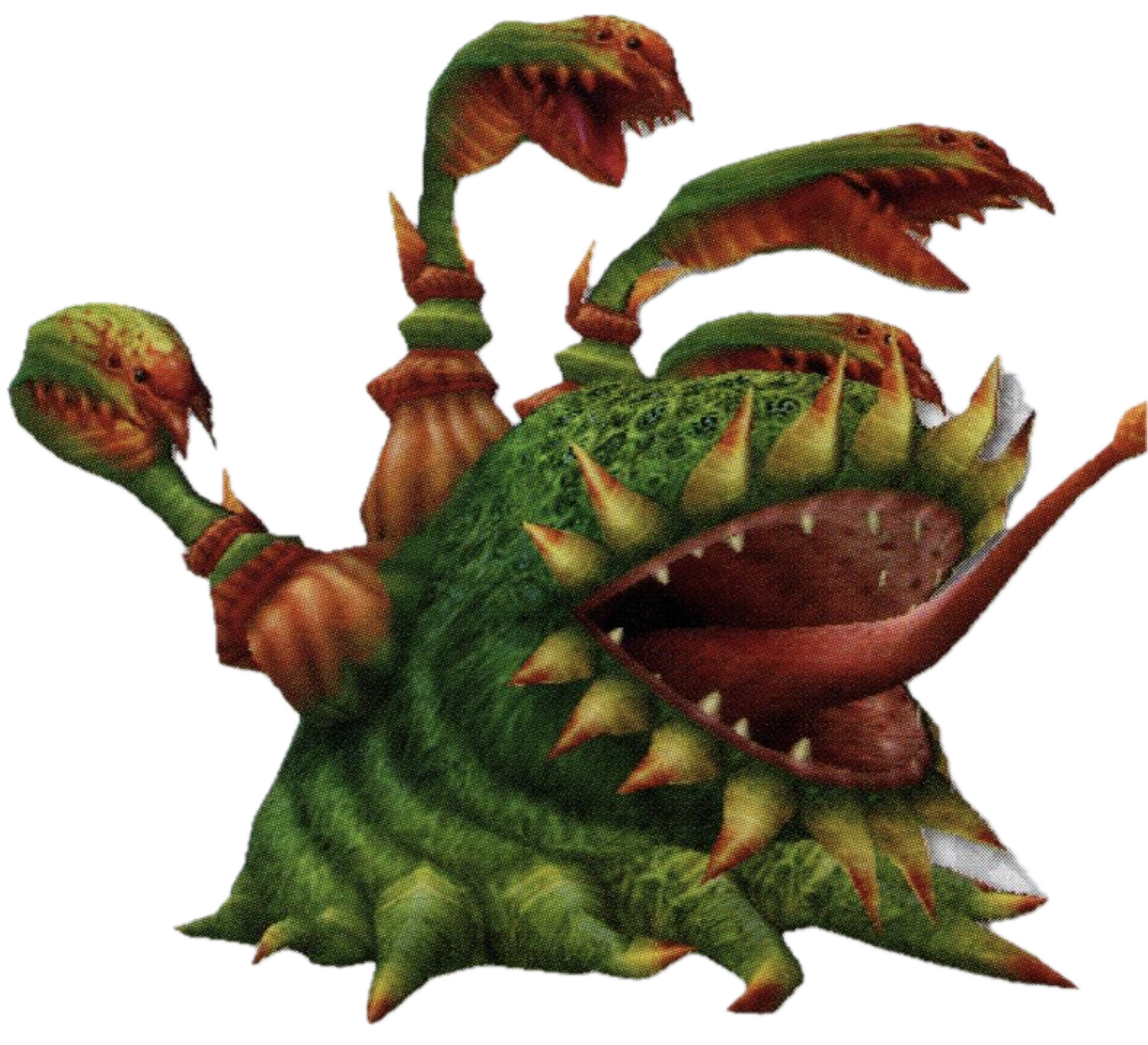
The malboro appears as a field boss encountered in the Eastern Wildlands, which can be rather difficult if accompanied by Goblin Healers.
Final Fantasy Dimensions
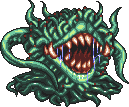
The malboro appears as an enemy encountered in the Lufenia Ruins and the Massive Cavern.
Final Fantasy Dimensions II
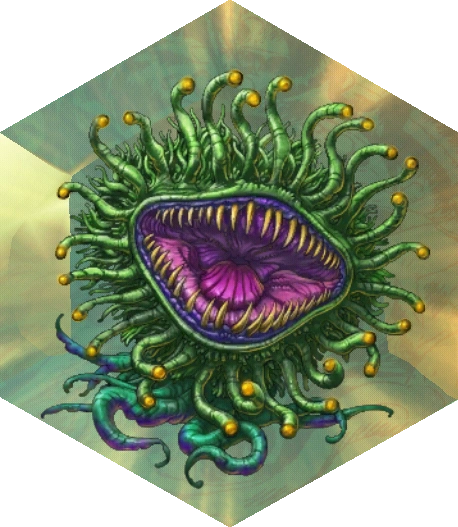
The malboro appears as an earth-elemental eidolon available to Aemo. It teaches the Dreadful Song ability and casts Consuming Mist when summoned, lowering enemies' attack and magic for 5 turns.
Dissidia Final Fantasy / Dissidia 012 Final Fantasy
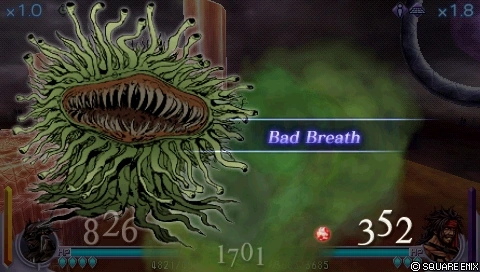
The malboro appears as a summon using its Final Fantasy II artwork. It casts Bad Breath when summoned, which causes bravery damage over time to the opponent, the damage increasing the shorter the distance between combatants. In the original release, it can be obtained as a Stage Bonus during the Destiny Odyssey II storyline. In Dissidia 012, it is instead purchased from certain moogle shops for 60 KP.
Dissidia Final Fantasy Opera Omnia
The malboro appeared as a boss encountered early on and was later a common mini-boss. Its appearance was based off its Final Fantasy VIII incarnation.
Theatrhythm Final Fantasy series
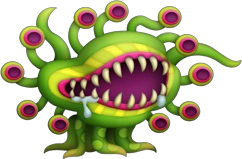
The malboro appears as an enemy during Battle Music Sequences.
Pictlogica Final Fantasy
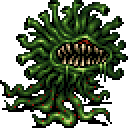
The malboro from Final Fantasy VI appeared as an enemy.
Final Fantasy Airborne Brigade
This section about an enemy in Final Fantasy Airborne Brigade is empty or needs to be expanded. You can help the Final Fantasy Wiki by expanding it.Final Fantasy All the Bravest
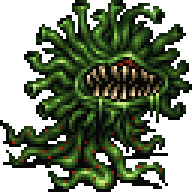
The malboro appeared as an enemy encountered in the Eureka Forest and Zanarkand Ruins. It used Bad Breath and dropped the partisan.
Final Fantasy Record Keeper


Malboros from Final Fantasy VI, VIII, IX, XII, and XV appear as bosses and enemies.
Final Fantasy Explorers
 This section about an enemy in Final Fantasy Explorers is empty or needs to be expanded. You can help the Final Fantasy Wiki by expanding it.
Final Fantasy World Wide Words
This section about an enemy in Final Fantasy World Wide Words is empty or needs to be expanded. You can help the Final Fantasy Wiki by expanding it.Final Fantasy Brave Exvius


Two generic malboros appeared as an enemies encountered during the global-exclusive trial "The Rumble of Malboro" and the Record Keeper Equipment Enhancement Event. In addition, malboros from Final Fantasy VII, IX, XII, and XV appeared during crossover events.
War of the Visions: Final Fantasy Brave Exvius
 This section about Summon magic in War of the Visions: Final Fantasy Brave Exvius is empty or needs to be expanded. You can help the Final Fantasy Wiki by expanding it.
World of Final Fantasy
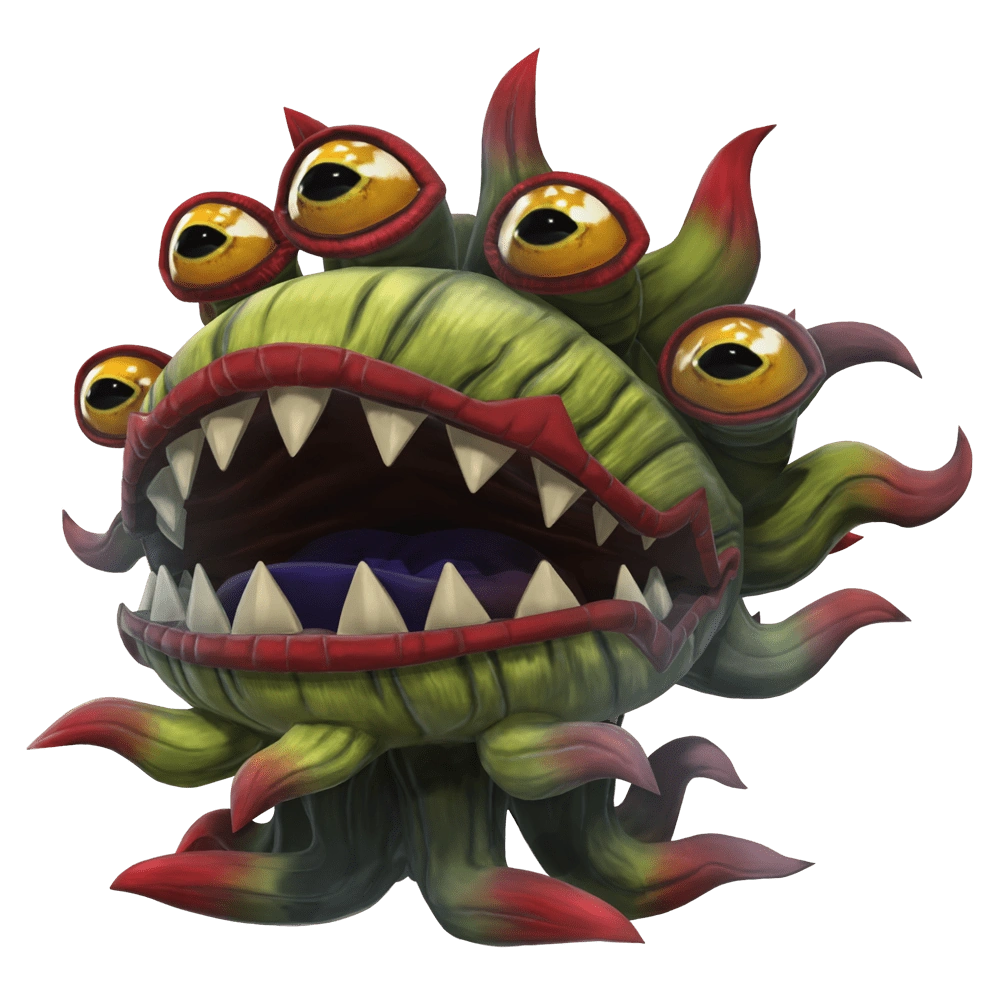
The malboro appears as an imprismable enemy encountered in the Windswept Mire, EX Dungeon A, and Coliseum. It can be transfigured with the mandragora and malboro menace.
Mobius Final Fantasy
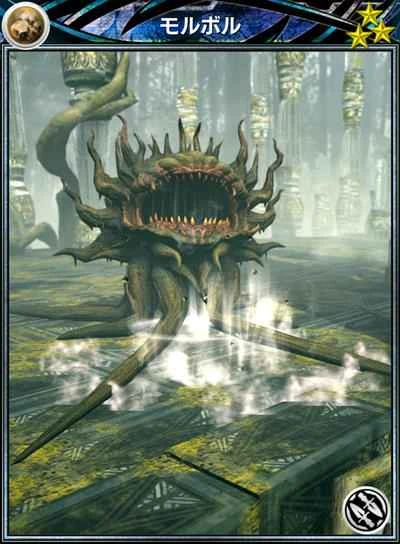
The malboro appeared as an earth-elemental enemy. It was obtained as a Ranger ability card, granting the Lesser Earthdance or Earthdance abilities.
Stranger of Paradise Final Fantasy Origin
This section about an enemy in Stranger of Paradise Final Fantasy Origin is empty or needs to be expanded. You can help the Final Fantasy Wiki by expanding it.Final Fantasy: Unlimited
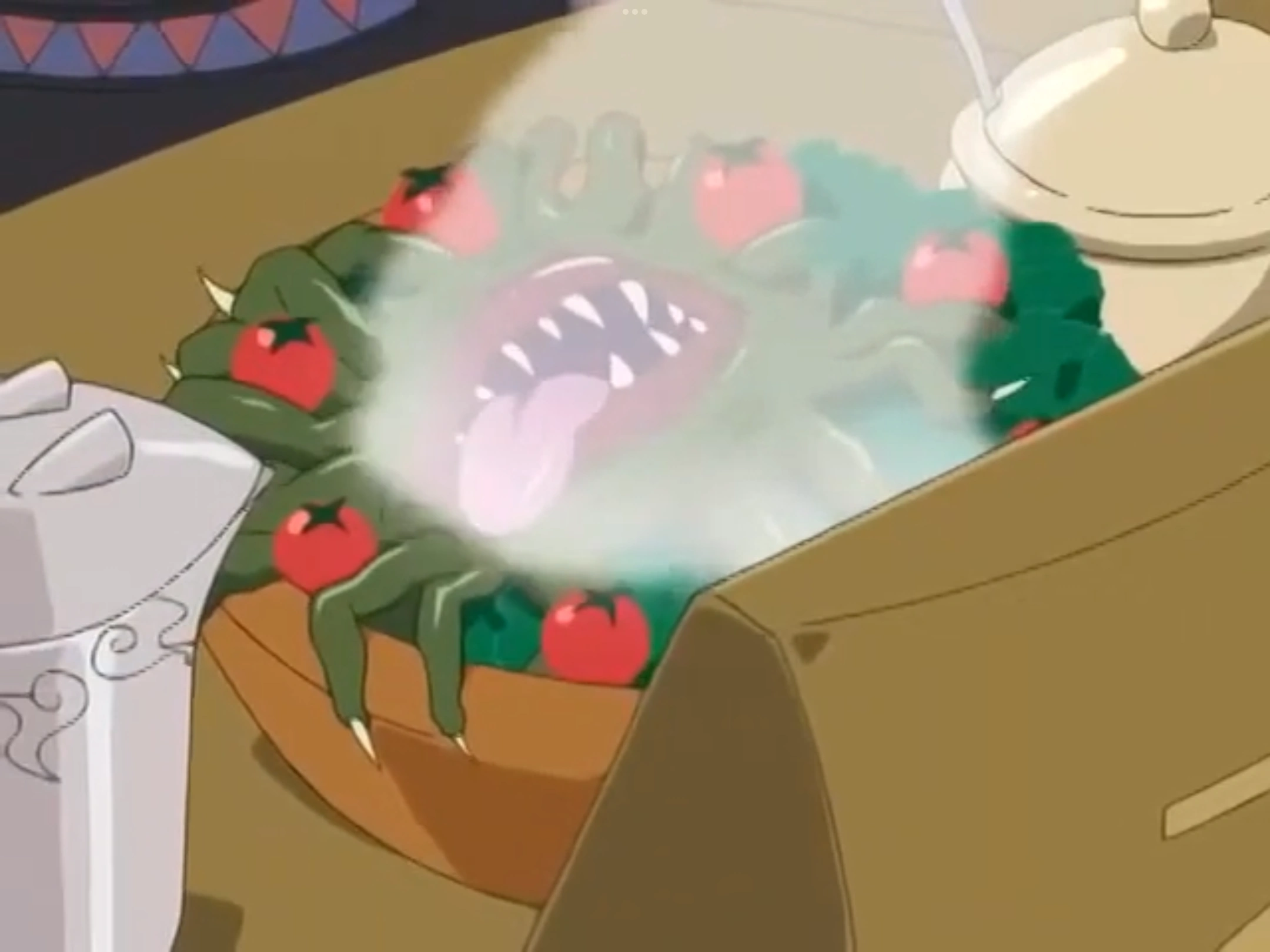
A malboro, called "marborja", cooked into a salad.
In episode 8, Earl Tyrant is served a malboro salad, but it is mispronounced "marborja". Notably, rather than having open tentacles, this malboro had spikes at the end instead, and was very small, fitting into a bowl.
Chocobo no Fushigina Dungeon
 This section about an enemy in Chocobo no Fushigina Dungeon is empty or needs to be expanded. You can help the Final Fantasy Wiki by expanding it.
Chocobo's Dungeon 2
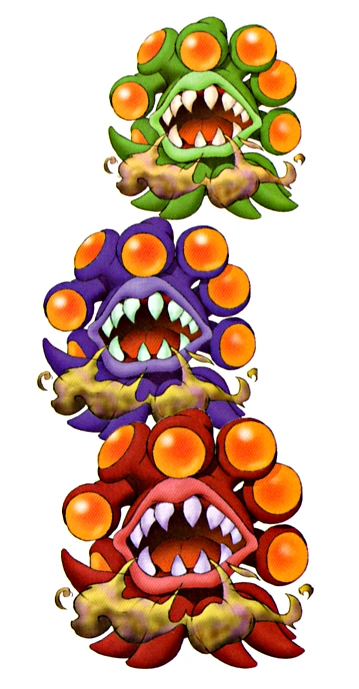
The malboro is sometimes encountered in dungeons. Also, a "drunken malboro" appears in a restaurant in the town.
Dice de Chocobo
This section about an enemy in Dice de Chocobo is empty or needs to be expanded. You can help the Final Fantasy Wiki by expanding it.
Final Fantasy Trading Card Game


Malboros from Final Fantasy X and Theatrhythm appear Water-elemental Monster cards.
Final Fantasy Portal App


The malboros from Final Fantasy VI, VIII, X, XIV, and World of Final Fantasy appeared as Triple Triad cards.
Non-Final Fantasy guest appearances
Dragon Quest & Final Fantasy in Itadaki Street Portable
The malboro appears as a chance card that increases pearl value by 10% on a random street.
Mario Hoops 3-on-3

Two malboros appeared in the secret court Malboro Gardens, one behind each basket. The malboros will sometimes attack with their purple Bad Breath, which knocks down players if hit by it and inflicts them with the Poison, which slows down characters. The malboros stray from their normal appearances, with only five eyes, each very large and pink, but still retaining their green skin.
Lord of Vermilion series


.png)


.png)


The malboro appears as a card in Lord of Vermilion III and Lord of Vermilion Arena.
Puzzle & Dragons
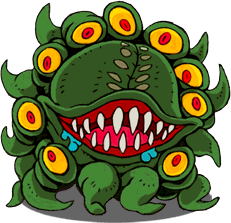

The malboro appeared as part of the Crystal Defenders collaboration.
 This section in Puzzle & Dragons is empty or needs to be expanded. You can help the Final Fantasy Wiki by expanding it.
Samurai Rising
This section is empty or needs to be expanded. You can help the Final Fantasy Wiki by expanding it.Mana series

The malboro appears as an enemy in various games in the series.
Dragon Quest Monsters: Super Light
The malboro appears as a recruitable monster during the crossover event with Final Fantasy Brave Exvius.
Magic: The Gathering
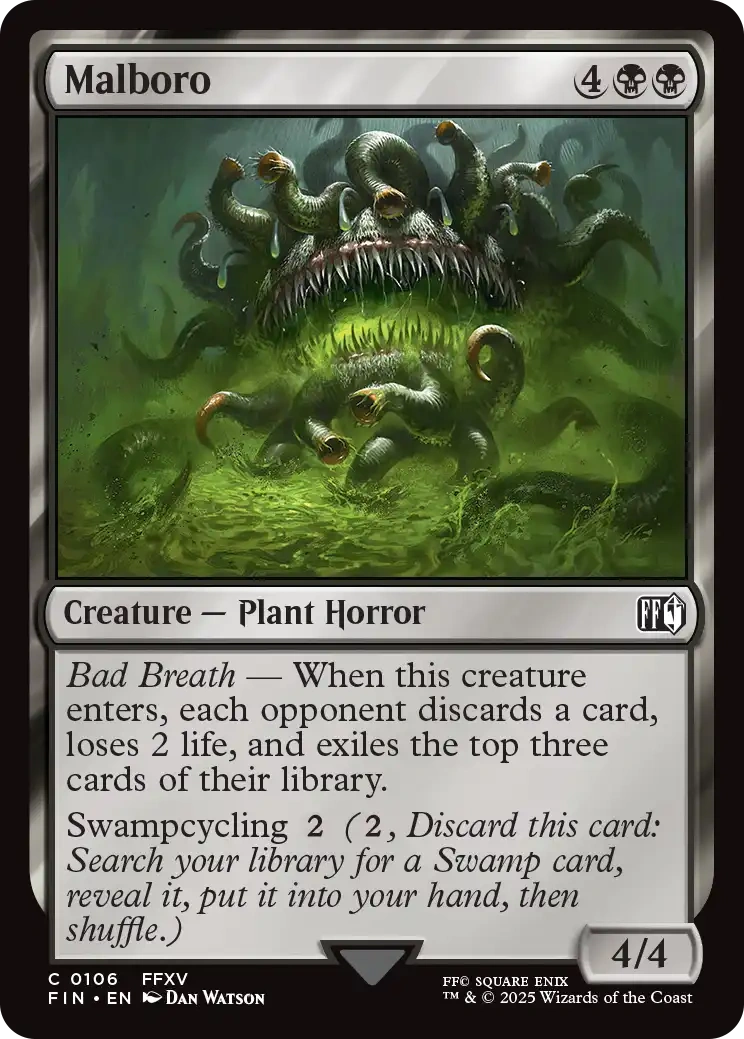
Etymology
The name may be a reference to Marlboro Cigarettes, since the creatures often spew horrid fumes from their mouths. The word "mal", originating from Latin, means "bad" or "evil" across many languages, including English, where it is not used on its own but can be found within words such as "malevolent" or "malefic".
The monster was originally known as "Mad Oscar" in Final Fantasy VI. This may be a reference to Oscar the Grouch of Sesame Street fame, who resembles a stringy green monster that lives out of a trashcan and is constantly grouchy. The change may have been to obscure the reference to a cigarette brand due to Nintendo's policy for kid-friendly content.