
Oh, shut up and help me remodel the Technology page!

I couldn't miss the chance to practice my drawing!
Technology is the series of technical and applied knowledge to help produce an intended result. Within Final Fantasy, technology often takes the form of that of human technology inspired by the real world, either from existing or to even conceptual examples, including those found in science fiction. The degree of advancement of technology varies from installment to installment, but in every appearance it is shown to have a great impact to the world and the story. Often, it is used to showcase a symbolic example of the "power of mankind" and the power of innovation and science. In many installments as a story element, technology is either juxtaposed or paired with that of magic, in that both methodologies are considered ways to harness the forces of nature with different results.
 This section is empty or needs to be expanded. You can help the Final Fantasy Wiki by expanding it.
Appearances
Final Fantasy
The Lufenians are said to be the most technologically advanced civilization in the game, having constructed the Flying Fortress, the Mirage Tower and an airship. However, much of their technology is wiped out prior to the events of the game, and the surviving descendants live in the city of Lufenia. A researcher in Melmond is looking for a way to decipher their language.
Final Fantasy III
The Ancients are shown to have mastery of technology, having possessed the ability to raise an entire continent when the greater world was in peril. To this end, an Ancient named Owen constructed a tower in his name, then gave his son Desch the task of its upkeep. Desch was placed in stasis, awakening only when the tower was threatened, but it left him amnesic. The Warriors of Light find Desch atop Dragon's Peak and guide him to his objective. The Ancients, meanwhile, settled in a village southwest of Castle Argus, but not before leaving a Time Gear with its people. The inhabitants of Saronia have acquired a vast knowledge of technology as well, having built the Nautilus. An unknown civilization built the Invincible, and secured it for hundreds of years until it was released.
Final Fantasy IV
The Lunarians were a technologically advanced race from an unknown planet that vanished in times past. Settling on the Red Moon, they watched over the Blue Planet and found its races underdeveloped. Many chose to enter sleep stasis, but one prominent Lunarian, Kluya, ventured outward to the planet. In the process, he taught humanity the secrets of airships, magic, and warp travel.
Final Fantasy V
Though it remains unknown exactly when they flourished, or if they are in any way connected to the division of the Crystals on the world apart from possessing one of the twin Earth Crystals, the peoples of ancient Gohn and Ronka may have been the most technologically advanced of the time. This is supported by the existence of several elaborate machines in the few structures that have survived the ravages of time.
As the game progresses, Karnak Castle emerges as the world's technological power, with its Fire Crystal giving life to machines like the Fire-Powered Ship. Cid Previa almost gives up on his research, but through the party and Mid, he gains a renewed zeal for his craft. He and Mid then assist the party in locating and restoring more ancient technology.
Final Fantasy VI
In the thousand years since the world was devastated in the War of the Magi, what remained of the population was divided into two planes. Humans, existing on the mortal plane, had struggled mightily to advance, while the espers sealed themselves off on their own plane. For much of this time apart, humans relearned their ability to craft civilization using the resources of their world.
Between 20 and 30 years prior to the start of the game, the seal between planes is weakened, allowing Madeline to stumble through and observe the espers' realm, later forging a bond with the esper Maduin. She unwittingly leads the Gestahlian Empire to its raid on the plane. In the process, no fewer than a dozen espers are seized and taken to what would become the Magitek Research Facility under Cid Del Norte Marguez. The espers are placed in fluid capsules for study, and their very life energy forcefully extracted to create Magitek, which is then infused into all matter, living or not, under Imperial control. Thus was Magitek Armor forged, enabling military use of magic.
Early experiments with Magitek were highly unstable, leading to the corruption of Kefka Palazzo. For this reason, General Leo Cristophe notably refused a Magitek infusion, yet became a top battalion commander. Later, Celes Chere is subjected to an identical process, but does not suffer psychosis as Kefka did.
Final Fantasy VII
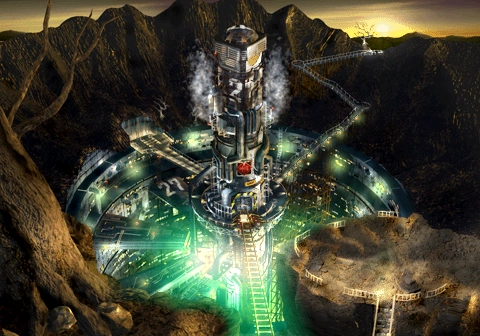

Mako reactor in Corel.
Tension between ecology/nature and technology is one of the game's core story arcs.
The Shinra Electric Power Company developed a method for expediting the planet's natural process of condensing, compressing and extracting its bio-ethereal energy into mako, which is then delivered as fuel to localities that rely on it. Comparable to coal and oil on Earth, Avalanche maintains the premise that the supply of mako is more finite than people believe and will destroy the planet once all is consumed, but goes to extreme lengths to prevent Shinra from further extracting.
Aside from this, some communities, notably Cosmo Canyon, Wutai Village, and Icicle Inn, have continued to flourish without using mako; tradition or an understanding of Gaia's inner workings is seen as a reason for said refusal.
Shinra is the origin of a lot of technology used on the planet in current day, from manufacture of cars and trains, supplying electricity. It aspires to space-travel with a space program that has, however, been on hiatus for years. Behind the scenes Shinra is associated with secret experiments on both humans and monsters and genetic engineering, its results having culminated in the SOLDIER program.
After the events of Meteorfall, and the public learning the truth about the Lifestream and its importance, the mako reactors were shut down, with the people returning to fossil fuels to serve as alternatives for an energy source.
Final Fantasy VIII
The Centra civilization (not to be confused with the Cetra people of the previous game) is stated to have created much of the world's early technology, though little else is disclosed beyond what is written in the game's supplementary material. They are known to have settled in the southern part of the world, where they built a castle, which in modern day houses the legendary Guardian Force Odin. Also believed to be nomadic, the Centra are credited with building the three mobile shelters that would become Gardens in the present day.
The current civilization is heavily dependent upon technology for daily living, with many regions wired into a high-definition cable network to expedite information transmission. Previous to cable, there was a network of radio towers serving the same purpose worldwide. Such towers, including one in the principality of Dollet, were disabled roughly 17 years before the story begins due to the worldwide radio interference phenomenon.
The city-state of Esthar remains the world's foremost technological power, and much about Esthar was concealed in mystery before the party discovered it in the present. Here one may find futuristic transportation as well as a fully automated shopping mall where customers can purchase items via touchscreen terminals. It was Esthar that was responsible for the discovery of Lunatic Pandora as well as methods for the containment and extraction of natural magic. From the latter, the Estharians also developed a sophisticated radio-jamming system so as to prevent interference with their containment systems.
Final Fantasy VIII is one of the few games in the series to depict space-travel in a somewhat realistic manner, in that there is a manned space station on orbit.
Final Fantasy IX
As part of the game's high-fantasy aesthetic, technology on the worlds of Gaia and Terra is kept to a minimum and is consistent with steampunk. Per the chronicles recorded in surviving structures, at its height, Terra was filled with cities and thus assumed to have developed and used advanced technology until the planet began to decay. Its overseer, Garland, placed hundreds of souls in stasis until such time as a thriving planet could be found for Terra to assimilate. He also created durable bodies in the form of the Genomes for these souls to inhabit. To travel between planets, the Terrans built the cruiser Invincible, which also became an instrument for culling non-Terran souls from the planet it was to assimilate, Gaia. Garland further crafted the Iifa Tree to regulate the flow of souls to and from Gaia. When said flow was not fast enough, he sent two of his Genome creations to accelerate it. The souls expelled in the process took the form of a noxious mist.
Meanwhile on Gaia, technology evolved somewhat naturally, with its first recorded appearance sometime in the second millennium of the Gaian calendar. The people of Lindblum, most of whom are skilled tradespeople, gradually developed mist-powered engines and vehicles that use them. However, when the party briefly halted the production of Mist, Lindblum's machinery was rendered useless and a new solution was needed. Regent Cid Fabool IX had been developing mist-free engines, but his lecherous ways got the better of him and his consort Hilda turned him into an oglop, shrinking his brain as well as his body. Thus, after the development of the Hilda Garde Mark I, none of Cid's plans were functional. The Mark II ship was able to fly to Alexandria, but was torn apart in the attack on the crown city. It was after he was reverted to human form that Cid was able to think clearly and logically; and so he completed the Mark III airship.
Final Fantasy X
As in Final Fantasy VII, a tension exists between technology and religion. One thousand years ago, the city of Zanarkand thrived on a hybrid of technology and magic, including sky scrapers and broadcast technology. At around the same time, the city of Bevelle thrived on technology more than magic. A great war took place between the two, with mixed results for each: Zanarkand fell despite a massive coordinated effort from its leader, Summoner Yu Yevon, and the citizens, resulting in the creation of the beast called Sin. Sin was given a number of directives to ensure that technology would never again develop to wartime levels and that Zanarkand at its peak would never fade. These directives were lost as the creature became just another mindless monster. Meanwhile, Bevelle replaced Zanarkand as the seat of the Yevon theocracy, in the process reducing their use of machina to devices used for self-defense.
Developing in parallel to Yevon's religion, the Al Bhed tribes would embrace technology in the pursuit of scavenging ancient artifacts and putting them to use. Yevonites resent and persecute the Al Bhed for their refusal to embrace Yevon's precepts. Technology outside the church and the Al Bhed tribes is limited, such as the populace using chocobo-powered ships that do not stray far from the coast.
Years later, as Yuna embarked on her pilgrimage to defeat Sin, the people of Spira would come together to fight a series of battles aimed at ending Sin's cycles of destruction in spite of their differences. One such battle combined Al Bhed machinery with Yevonite manpower, though it ended in mass bloodshed as Sin attacks. Ultimately, it would fall to the party and the airship Fahrenheit to go inside Sin's body and destroy the remains of Yu Yevon at its core.
By the time of the sequels and gaiden material, technology was slowly reintroduced into Spiran society alongside new takes on religion and politics following the fall of Yevon proper. Its ultimate fate as of the audio drama Will remains unknown.
Final Fantasy XI
Final Fantasy XII
Final Fantasy XIII
Final Fantasy XIV
Final Fantasy XV
The world of Final Fantasy XV has roughly modern day technology, with Insomnia modeled after contemporary Tokyo. Internet and smartphones and modern day cars exist, though the outlands of Lucis appear less advanced than the crown city.
The Niflheim Empire employs magiteknology to produce various apparatus, among them the magitek infantry, magitek armor, airships, and magitek rifles wielded by the imperial infantry. Niflheim has been using magitek for centuries, appropriating the technology from the ancient civilization of Solheim. The technology was further developed by Verstael Besithia with help from Chancellor Izunia to power it with miasma manufactured in imperial facilities. The Wallbreaker Wave technology is used to block out the power of the Lucis dynasty, with exception of the Ring of the Lucii. Mass production of magiteknology requires enormous quantities of oil and coal.
Final Fantasy XVI
Modern day Valisthea lacks advanced technology, but past civilizations were rife with it. Due to lack of technological advancement, Valisthean society exploits enslaved Bearers to maintain their society.
The Fallen made use of magitek in their clockwork machines and airships, but the Fallen civilization came to an end 1,500 years ago. Magitek was a highly advanced magical technology that even produced weapons nigh indistinguishable from living beings whose destructive power rivaled "the gods of legend". The early chroniclers labeled these living magitek creations the "Eikonoklastes".[1] Final Fantasy XVI Ultimania elaborates that powerful magic-users were needed to operate this magical technology.
In modern days, the "living clockwork machines" are known as echoes, and though commonly found in Fallen ruins and thus believed by the modern populace to be vestiges of their skybound civilization, were originally servants of Ultima.[2]
Final Fantasy Type-0
Technology in the world of Orience is in the service of waging war; though the level of technology is fairly modern, especially in Milites, no "entertainment" technology is seen, such as television. Milites appears the most technologically advanced Crystal-Nation due to their White Tiger Crystal, which can empower technology, and so Milites has many advanced weapons, such as the Ultima Bomb, and various magiteknology, and is the only nation shown to have trains and cars. The Dominion of Rubrum still has airships for an air force, whereas the Kingdom of Concordia uses dragons and appears less technologically advanced, using control of monsters and flying wyverns for warfare. Rubrum's technology is magic-based due to their Vermilion Bird Crystal, employing things like mechanical-looking summons, teleportation gates, and firearms that shoot magic.
As a visual element, the world of Orience is associated with constantly moving clockwork gears, this motif recurring in various designs in the game. However, this refers more to the spiral of souls than to how technology operates in the world of Orience.