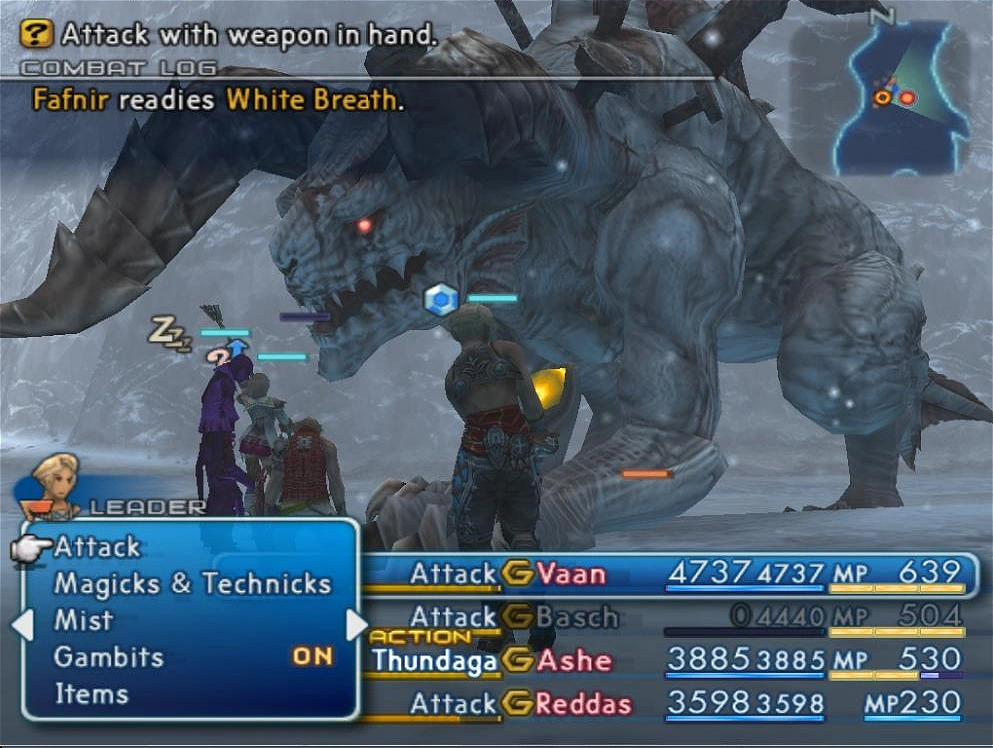

Fafnir in Final Fantasy XII only spawns during a snowstorm.
Spawning enemies is a gameplay feature appearing in Final Fantasy games that do not have random encounters, where enemies often spawn on the field. Engaging them initiates a battle.
Appearances
Final Fantasy VIII
Within Ragnarok, the player must clear the airship of Propagators. The Propagators act like bosses, with the boss theme playing during battle and the party is unable to escape, but they can be seen on the field and thus avoided. The player must kill them in colored pairs or otherwise the Propagators will respawn and must be defeated again.
Final Fantasy IX
While enemies normally appear in random encounters, enemies spawn on the field during the Festival of the Hunt and coming into contact with one triggers a battle. Zaghnol, the most powerful opponent, will only spawn within the Business District's Fountain Square of Lindblum when less than four and half minutes appear on the clock.
Final Fantasy XI
Every monster has a set amount of time after death before they respawn. On average, regular monsters take five minutes to respawn in field areas, and fifteen to respawn in dungeon areas. Every Notorious Monster has a specific way for them to spawn, be it a specific amount of time, such as half an hour to two hours, or a "lottery spawn", when a Notorious Monster will spawn instead of one specific monster.
This monster must be killed in order for the notorious monster to appear. One other notable method of spawning Notorious Monsters is known as "force spawn", where a monster is spawned by either trading an item to a "???" on the ground, or by examining the "???" with the required key items.
Final Fantasy XII
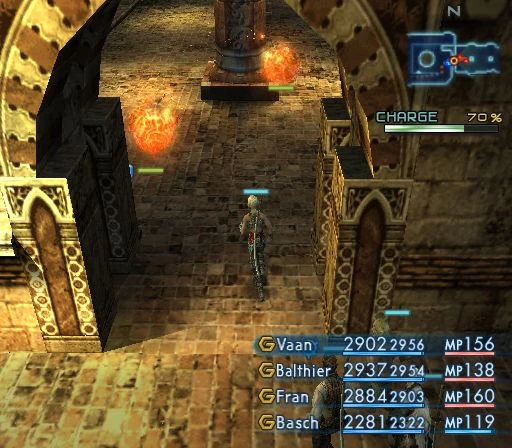

Bombs in Barheim Passage are neutral enemies.
Opponents, and sometimes random non-playable allies, spawn on the field, but many enemies spawn only when a special condition is fulfilled. Most zones have a maximum limit of six enemies at once, but there are some exceptions. Most enemies in the game have a chance to spawn when the player simply enters the area, but there are also enemies that only spawn during specific weather conditions (Entites especially) or only after the player has stayed in the zone/area long enough time. Rare Game usually have much more specific spawn requirements, such as spawning only when another enemy is killed, or when the player kills all enemies of a specific type, or all enemies in the area.
Most enemies spawn when the player is close enough to see them. However, some enemies spawn suddenly, such as jumping out of water (frogs), coming out from the ground (undead), dropping down from above (flan) or just simply appearing out of nowhere, like in the case of some reapers.
Final Fantasy XIII
The enemies' spawn mechanics are rather straightforward. Enemies have a specific spot on the field where they spawn. When a player moves past them, the enemies may try to chase the player, but soon return to their original spawn spot, and won't chase players across maps like in Final Fantasy XII. The enemies respawn once the player moves far enough away from the spawn spot, then returns. Enemies fought as part of missions will not spawn unless the player first activates the mission.
Final Fantasy XIII-2
When the party travels across the map, monsters emerge at random intervals. This system is a kind of mix between the old-fashioned random encounters, and the more recent system where monsters are engaged on the field. When monsters emerge, the Mog Clock activates. If the player engages the enemies by slashing them with their weapon, they begin the battle with a preemptive strike. The player can avoid encounters by running away from the enemies after they have appeared on the field, but if they run out of time on the Mog Clock, the battle will initiate anyway with the party being unable to escape.
Lightning Returns: Final Fantasy XIII
Enemies spawn on the field. Which enemies spawn where and how frequently depends on time of day. Usually only one enemy/enemy group spawns at a time. Some areas are monster-free, and after killing the Last One of a monster species, they will go extinct. In Chaos infusions, stronger variants of the enemies spawn with boosted stats who give better battle spoils. Enemies emerge randomly, and Lightning must come into contact with them on the field to initiate a battle. If Lightning runs, the enemy may pursue for a while, but eventually disappears.
On Normal and Hard Mode battle difficulties, attacking enemies who are yet to notice Lightning starts a preemptive battle where the enemy loses 25% of its HP at the start. Attacking enemies first loses 10% of their HP, and if an enemy initiates a battle Lightning loses 10% of her HP. Special enemies, like some bosses and Last One monsters, leave treasures on the floor after being defeated.
Final Fantasy XIV
Overworld enemies will respawn shortly after being defeated. If an enemy wanders too far from its jurisdiction, it will become invulnerable to damage and return there, fully recovering its HP. Enemies inside dungeons are generally exempt from this, not returning unless the party loses enmity entirely.
Many duties, as well as FATEs on the overworld and instanced quest battles, will have additional enemies spawn in, which must be taken care of.
Marks have certain spawning conditions but function similarly to other overworld enemies in behavior.
War of the Visions: Final Fantasy Brave Exvius
While uncommon in the earliest missions, several missions involve battles that can spawn one or more additional enemies, often upon the defeat of a specific enemy already on the field. The action queue on the left of the screen will be halted while spawning takes place.
Etymology
In video games, spawning is the live creation of a character or item. Respawning is the recreation of an entity after its death or destruction.