The first Final Fantasy is subject to numerous ports, with new releases adding new content and removing bugs and glitches presented in the original version.
Famicom

The first iteration of Final Fantasy was released on December 18, 1987.
MSX2
The first re-release of Final Fantasy was released December 1989 in Japan only.
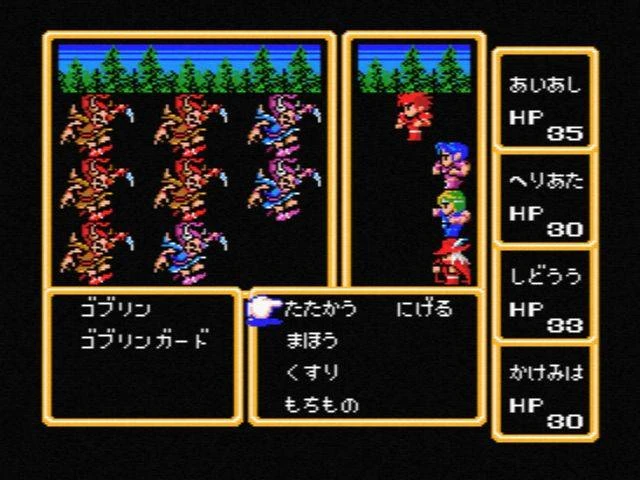

A battle (MSX2).
The MSX2 computer standard was roughly analogous in terms of technical capabilities compared to the Famicom, and as such, the MSX2 version of Final Fantasy is nearly identical to the original Famicom version. While the Famicom was designed to operate exclusively as a gaming console, the MSX2 was intended to be used more generally as a personal computer. Thus the game was subtly altered to take advantage of certain features offered by the MSX2 compared to the Famicom.
- Format – Released on floppy diskette, the MSX2 version has almost three times as much storage space compared to the Famicom (720 KB vs. 256 KB), but suffers from a variety of problems not present in Nintendo's cartridge media, including noticeable loading times.
- Updated visuals – The MSX2 version sports a minor but noticeably improved color palette that adds a degree of vibrancy to characters and backgrounds.
- Save system – Game data could not be saved onto the original program diskette, requiring a blank floppy diskette to save one's progress. It was possible to store only one saved game on any given disk at one time, although it was possible to have multiple diskettes for multiple saved games.
- Sound and music – The MSX2 features more sound channels than the Famicom, and thus music and sound effects were altered or improved for the port. Several Dungeon themes were changed for specific locations. These changes are exclusive to MSX2 version.
- Chaos Shrine and Sunken Shrine changed from "Chaos Shrine" to "Sunken Shrine", while Past Chaos Shrine was changed the other way.
- Marsh Cave was changed from "Dungeon" to "Matoya's Cave".
- Giant's Cave was changed from "Mt. Gulg" to "Sunken Shrine".
- Mirage Tower was changed from "Dungeon" to "Mt. Gulg".
- Gameplay changes – The Monk's unique attack and defense formula when using no weapons or armor are nonfunctional. As such, the Monk is significantly weaker than in other versions. This was fixed in later versions.
- Performance - The increased storage on the floppy disk resulted in an increase in loading through battles as well as a more static movement for characters.
- Random encounters – Encounter mapping on the world map is shifted 7 tiles east and 6 tiles south, resulting in slightly different encounters on the world map. This shift occurs exclusively in the MSX2 version.
Nintendo Entertainment System
The first international edition of Final Fantasy, released on July 12, 1990. It is the North American localization of the original game.
Almost identical to the original Famicom version, technical limitations and the censorship policies of Nintendo of America resulted in a few minor changes to certain elements:
- Shortened Magic terms – The original game program provided only four character spaces for magic spell names, meaning a number of the Japanese spell names had to be abbreviated to fit the space requirements for the English version. These changes include "Flare" being reduced to "NUKE" and "Thunder" to "LIT".
- Sprites - Sprites for nearly every character, specifically the selected jobs, were given visual updates.
- Sprites when selecting a weapon from an item shop were implemented.
- The Evil Eye and Death Eye were given new sprite designs and their names changed from the "Beholder" due to copyright issues with a similar enemy in Dungeons & Dragons.
- The Medusa and Earth Medusa sprite were altered to cover bare breasts.
- Censorship – Nintendo of America's policy prohibited games from featuring any overt Judaeo-Christian imagery or reference to death. Churches no longer featured crosses, the Death spell was renamed to "RUB", and the Kill spell was renamed to "XXXX".
- The columns in the final floor of the final dungeon form a Star of David, a Judaeo-Christian symbol, which is reduced to a triangle. The random encounter data is removed from this floor, making it easier to prepare for the final battle against Chaos. This change is reverted in all subsequent versions.
- Random encounters:
- Random encounters no longer occur on the final floor of the Chaos Shrine.
- Encounter rates in the Flying Fortress are slightly adjusted to increase the chances of Warmech appearing. This change is reverted in all subsequent versions.
Final Fantasy I∙II
A compilation of both Final Fantasy and Final Fantasy II, released on February 27, 1994 in Japan only.
Incorporates the enemy sprite changes from the NES version, specifically the Evil Eye, Death Eye, Medusa and Earth Medusa with the former two retaining their original Japanese names ("Beholder" and "Death Beholder"). Several guidebooks released for the compilation such as the Final Fantasy I∙II Kanzen Kōryaku-hen still use the original sprite designs of these enemies.
WonderSwan Color
Released on December 9, 2000 in Japan only. A number of major changes were introduced for the WonderSwan version:
- Updated logo - An updated logo using the standard series font featuring the Warrior of Light.
- Upgraded visuals – The WSC versions use 16-bit pixels equivalent to the Super Famicom, which included larger color palettes and full background images for battles.
- Party – Character sprites such as the upgraded classes were redesigned to more closely resemble the designs of the Super Famicom Final Fantasy titles.
- Shops - When accessing a shop, each room can now be explored, each with a counter where the shop menu can be accessed.
- Battles - Battle screens were redesigned to resemble the battle screen layout used from Final Fantasy II onwards, with all textual information moved to a blue window on the lower screen and battle information on the upper screen.
- Cutscenes – New cutscenes using the in-game sprites were added to expand the game's story, including the construction of the bridge by the Cornelian army.
- Increased text boxes – The WonderSwan version removes the restriction of being unable to display more than one window of text when interacting with NPCs. The original Famicom version could not display more than one window of text during a conversation, which meant that all conversations with NPCs were limited in length.
- Battle changes – Failed actions when attacking defeated monsters have been removed; e.g. a character that targeted "Enemy A" will no longer miss and instead redirect their attack to "Enemy B". In addition, enemies afflicted with a status spell will be visible in battle, such as the Silence icon.
- The specific spells and equipment that were not correctly functioning in the NES version have been fixed.
- Equipment - Equipment can now be removed from a party member when attempting to equip the same item to another member, instead of being locked to one party member only.
- Movement - The option to "Dash" was introduced: holding down a specific button while walking around a town or dungeon will double the character's movement speed. Both options can be toggled via the game's configuration screen.
- Spells – In the original version, Jobs which can cast magic have successive "spell levels", with each having three available slots per spell level, but can choose from an additional fourth spell. Once selected, it was not possible to "unlearn" spells in order to free up space for the unchosen fourth spell. The WonderSwan version enables the player to delete purchased spells.
- Saving – The WonderSwan version provides up to eight individual slots for saved game data. The "Quicksave" feature allows the player to save progress at any time outside of battles. This will exit the game, however, and as soon as the game is resumed any Quicksave data is lost.
- Items – In the original versions, only items specifically assigned to a character could be used during battle. In the WSC, there is a party-wide "pool" of items that can be accessed at any time by all characters. Certain status healing items and spells (such as Life and Soft) could now be used during battle. The status ailment Silence no longer prevents items from being used.
- Music – In addition to rearranging the original soundtrack, several newly composed songs were arranged by Nobuo Uematsu.
- Enemies – Certain bosses and enemies have had their HP increased to balance the difficulty.
- Maps - Improved textures have resulted in slight changes to map geography throughout the game. Additionally, the world map is shifted 3 tiles south and 1 tile west, and is now 255x255 rather than 256x256; the removed tiles are all ocean tiles. Its encounter mapping is shifted the same values, leaving it functionally unchanged outside of changes in geography.
- Random encounters:
- River and lake encounters are now the same across the entire world map. In prior releases, the northern and southern halves of the map had different encounter sets for rivers.
- Swamps and deserts can now have unique encounter sets, though in practice this results in only minor changes to encounters in the Caravan, Citadel of Trials, and Onrac regions.
- 15 Puzzle - Dialog boxes were added when playing the minigame. The top-right box shows the count-up timer and the bottom box lists the controls. Items will be awarded to the player if they were able to solve the puzzle quickly before certain minutes passes, though they will always receive 100 gil upon completion. Completing it under record time for the first time awards also gives the player many gil as well.
PlayStation
An enhanced re-release for the PlayStation was released along with Final Fantasy II, titled Final Fantasy Origins (or Final Fantasy I+II Premium Collection in Japan). Both games are based on the WonderSwan Color versions, retaining most of the changes featured. The game was released on October 31, 2002 in Japan, followed with a March 14, 2003 release in Europe and a April 8, 2003 release in North America.
Along with the WonderSwan Color changes, additional features were added:
- Updated visuals – Visuals have higher resolution with new graphical effects.
- Rearranged soundtrack – Improved sound quality for music equivalent to the existing Final Fantasy titles on the PlayStation, with additional tracks added by Nobuo Uematsu.
- Localization – The Japanese version's script was changed to include kanji. English localization has been improved and retranslated to more closely follow the original Japanese script and terminology. Character and spell lengths were increased from four to six characters. The jobs Fighter and Black Belt are renamed Warrior and Monk, respectively.
- Save system – Saved game data takes up one block on the PlayStation memory card, which means that up to fifteen games can be saved onto each card. The "quick save" feature of the WSC version was excised, but in its place a "memo save" feature was introduced where game data can be temporarily saved to the PlayStation's RAM. The data remains until the system is turned off, or its power supply is otherwise interrupted.
- Full motion video - An introductory FMV appears before the title screen featuring the Warrior of Light.
- Bonus content - An "Omake" (or bonus) section was made available that includes a Bestiary, an Art Gallery and an Item Collection, which are unlocked as the player progresses through the game.
- Easy mode – A new "easy mode" was introduced wherein shop prices are cheaper and experience levels are gained faster with more rapid stat growth. Specifically, the Mage/Wizard spell pools are more generous and extend to the double digits for each level, unlike the standard mode where they cap at 9 per level. This mode is optional and can be chosen at the title screen.
- DualShock support - The game features rumble support with the DualShock controller.
- Easter egg - A well known Easter egg in the NES version was featured on the gravestones with the description "Here lies Erdrick", referring to the protagonist of Dragon Quest III. They now say "Here lies Link", referencing the protagonist of The Legend of Zelda series.
Game Boy Advance
A third compilation of both Final Fantasy and Final Fantasy II titled "Dawn of Souls" was released in Japan on July 29, 2004, North America on November 29, 2004 and Europe on December 3, 2004. The Game Boy Advance edition featured a number of substantial changes to both titles:
- Adjusted difficulty – The GBA version's difficulty is based off the Easy Mode of the Origins version, though there is no option to adjust its level. The redirection of "ineffective" hits, which had been optional since it was introduced in the WSC version, is now mandatory.
- Localization - The North American translation was further polished from the Origins port, with the European version featuring the option to change languages: English, German, French, Italian and Spanish. As a result, the PAL versions feature thinner font to accommodate the language-specific pronunciations.
- Visuals – Higher screen resolution with the overall presentation identical to the Origins version, while featuring a brighter color palette from the WonderSwan port.
- Magic system – The "spell level"-based magic system was dropped in favor of the magic point-based system used in more recent Final Fantasy games. Although spells are still classified at certain levels for some purposes (characters can still only be equipped with three of the four available spells of any given level), every spell is now assigned a point value. When cast, that value is subtracted from a total number of MP that applies to all spells known by a character.
- Items – Many new items were introduced, including the Phoenix Down and stat boosting items. Healing items are now easier to procure and are less expensive. The player can also now obtain item drops from enemies.
- Bonus content – The Art Gallery and Item Collection present in the Origins version have been omitted, but the Bestiary gallery remains and operates in much the same way.
- Gameplay changes – Certain classes have been modified: the Thief and Monk have become more powerful, whereas the Red Mage has become less so. Stat growth has been altered, and Intelligence now affects the strength of weapon-based magic spells. The Intelligence bug is fixed.
- At the beginning of a new game, the party starts with 500 gil instead of 400 as in previous versions and are already equipped.
- The past Chaos Shrine is no longer a point of no return and can be walked out of by walking on top of a black puddle where the party enters from, making Exit or Teleport no longer necessary to leave.
- Movement - The option to sprint with a button has been altered to now feature the option of either normal traversal or always sprinting.
- Save system – The game can now be saved at any time outside of battles instead of saving at an inn or when using a tent, with three available save game slots.
- Enemies – Certain bosses and enemies have had their HP further increased from their WonderSwan Color values.
- Auto-naming – When selecting a Job, the player can choose a randomly assigned name to each character. The names are based off characters through Final Fantasy III to Final Fantasy VI along with several from Final Fantasy IX.
- Soul of Chaos – Four new optional dungeons have been introduced, one corresponding to each Fiend, and become available after that Fiend is defeated. The dungeons are especially challenging and feature items and monsters not found elsewhere. At the end of each dungeon there are a variety of boss monsters from subsequent games through Final Fantasy III to Final Fantasy VI.
- Level cap - The level cap is increased from 50 to 99.
- Critical hit bugfix - The critical hit bug is fixed, but all original weapons have their programmed critical hit rates changed to match their index number, allowing them to retain the same critical hit rate as prior releases. The critical hit rates of newly introduced weapons work as intended, unaffected by their index number.
Mobile phone
Released on March 1, 2004, Bandai Namco Entertainment released a mobile port of Final Fantasy worldwide as a Java game. The game was priced around $4.99 and is 600 KB in file size. This version is based on the NES release, but with some noticeable differences. Some of these changes in this version (barring those already made in other non-NES releases) are not present in other versions.
- Bug fixes - Bugs present in the NES version were largely fixed, excluding the "Peninsula of Power" and critical hits.
- Scripts - The script has been further readjusted.
- Inventory - An expanded inventory system, allowing the player to carry every item present in the game.
- Quicksave - A Quicksave function that can be toggled, the game saves to a separate Quicksave slot whenever the player enters a new room or floor, and the file is erased upon being loaded. In difficult dungeons, this feature can be exploited by stepping out of the room or entering the last set of stairs, then re-entering to ensure the Quicksave file is not erased. If the party is slain or the player needs to reset, the Quicksave file may be used to retain the player's position in the dungeon.
- Option toggle - Dashing and re-targeting, both of which may be toggled off and on (similar to the WSC and Origins versions).
- Enemies - Some enemy groups have been rearranged. Stronger enemies are sometimes encountered much earlier in the game. Chaos now has double the amount of HP.
- Jobs - The Knight and Ninja classes no longer have their Spell Charge capped at 4, with both advancing up to 9 charges per spell level.
- Minigame - The 15 Puzzle minigame is inaccessible.
- Sound - Sound effects are absent, but the player may choose to toggle the BGM, with the music rearranged in MIDI format that does not loop. The boss battle themes are absent, excluding the final battle with Chaos.
- Visuals - A combination of both the GBA and NES versions with detailed sprites but retaining the map and dungeon designs of the NES version.
- Items - Hi-Potions, Phoenix Downs, and other new items introduced in the GBA version are not present.
- Bonus content removed - No hidden extras are featured in this port. Clearing the game only displays the ending sequence, with no option to save and begin a New Game Plus file.
PlayStation Portable
A PlayStation Portable version was announced in celebration of the series's 20th Anniversary, released on April 19 in Japan, June 26 in North America in 2007, and February 8, 2008 in Europe. In addition to retaining the FMVs from the Origins version, additional changes were featured:
- Updated logo - An updated logo that still features the Warrior of Light, now in a different pose. It has since been used in all media that features Final Fantasy.
- Visuals – Sprites in both characters and environments have been updated and are more detailed, with new aerial effects added to the towns and dungeons, such as clouds passing through the sky.
- Gameplay changes - The "Defend" command has been added for battle menus, and cutscenes can now be skipped.
- Music – The Origins version of the soundtrack is retained. In addition, the battle music for the Dawn of Souls bonus dungeons has been replaced with the respective boss theme of the original game. E.g. the Hellfire Chasm, which features bosses from Final Fantasy IV, features the "Battle 2" theme from the same title.
- Labyrinth of Time – A new dungeon with greater difficulty in addition to the new superboss Chronodia, whom surpasses even Omega, Shinryu, and Chaos in difficulty.
- Art gallery – The art gallery featured on Final Fantasy Origins has returned.
- Full motion video – The FMV scenes have been updated to feature the Square Enix logo that replaces the original Squaresoft version, as well as the new version of the Final Fantasy logo.
- Item adjustments - The Fang items (Red Fang, Blue Fang and White Fang) now use a fixed Intelligence value of 45 instead of the user's Intelligence for damage calculation (the user's Luck is still used), which makes them far more powerful early on.
Wii Virtual Console (discontinued)
The original title was re-released as part of the Virtual Console library of retro games on the Nintendo Wii. The original Famicom version released on May 26, 2009 in Japan, while the English versions released on October 5, 2009 in North America and May 7, 2010 in Europe.
- The game is not available on the 3DS and Wii U Virtual Consoles outside of Japan.
- All versions reduced the flashing effects from spells.
- The Famicom version uses the revised name and sprites for the Evil Eye, Death Eye, Medusa, and Earth Medusa, with the uncensored version of the sprites used for the latter two.
PlayStation Network
Two versions of Final Fantasy were re-released digitally on the PlayStation Network on June 24, 2009 in Japan and February 16, 2011 for Europe and Australia. Final Fantasy Origins is available for download in North America for the PlayStation Portable, PlayStation 3 and PlayStation Vita, while the Anniversary Edition versions are available for download in Europe and Japan for the PSP and PS Vita only.
2010 (delisted)
The now discontinued mobile ports of the 20th Anniversary version were released on February 25, 2010 for the iOS and on July 27, 2012 for Android. The Windows Phone version released on June 4, 2012 in Japan and June 13, 2012 worldwide. These versions were available up until July 28, 2021 and were replaced by the Pixel Remaster series version.
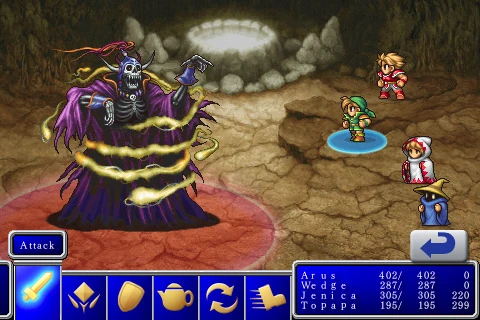

A battle in Final Fantasy on iOS.
- Touch controls - Implementation of touch-based controls, with reworked menus during battle to accommodate the changes.
- Removed features - The option to change the window color was removed. The Art Gallery has also been removed. In the Android version only, the Soul of Chaos dungeons and the Labyrinth of Time were removed.
- Music - Quality of the soundtrack has been reduced.
- Bugs - HP and MP values when gaining a level increase on the minimum values instead of being selected randomly.
- Windows phone features - Features unique to this version include a phone status indicator. including time, signal, Wi-Fi status and battery levels on either side of the screen, in addition to achievements.
Nintendo 3DS
A port of the Anniversary Edition for the 3DS is included with first print copies of Final Fantasy Explorers. It was later released on the eShop on January 21, 2015 in Japan only.
- Graphics - New 3D graphics implemented in towns and dungeons adding depth to the environments, which is used in conjunction with the Nintendo 3DS's Stereoscopic 3D.
NES Classic Edition
The original NES version of Final Fantasy is included in the international NES Classic Edition, released on November 11, 2016. The console is a miniature replica of the Nintendo Entertainment System with and includes a static library of 30 built-in games that supports multiple save states, in addition to having compatibility with accessories for the Nintendo Wii.
Final Fantasy Pixel Remaster
As part of the series of Pixel Remaster re-releases of the first six games in the main series, the first three games were released on July 28, 2021 for both Steam and Mobile.
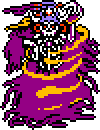
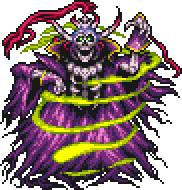
Original NES sprite of the "Lich" (left) and the updated Pixel Remaster depiction (right).
- Pixel Remaster - Refined pixel art presentation built with the Unity engine. Character and enemy designs have been further revamped, with the latter now using designs based on the original 8-bit installments. NPC sprite designs are lifted directly from later releases of the original game and Final Fantasy V. Environmental effects from the Anniversary versions are retained.
- Originally the boss character sprites of the Four Fiends and Chaos on the field map were based from the Dawn of Souls version, which have not had their appearance updated to reflect the new battle sprites, though were mostly in different colors compared to the Dawn of Souls sprite. This error was fixed in a later update.
- Princess Sarah's hair is recolored pink, reflecting her modern appearances in other media. The hair of her mother, Jayne, and her sister were also recolored pink.
- New animations for items and spells have been remade in a style similar to those in Final Fantasy V.
- Video filters - An option to display the game using a CRT filter, emulating the display of retro games.
- Resolution - Exclusive to the Steam version are multiple options to adjust aspect ratio and screen resolution.
- Tap mode - Exclusive to the Mobile version is the option to tap to reach a specific tile when on the field.
- Localization - The game reuses the localization from the Dawn of Souls and 20th Anniversary versions, with some additional polish. In addition to retaining all European language options from the Dawn of Souls version, new languages are now available: Korean, Brazilian Portuguese, Russian, Thai, Simplified and Traditional Chinese.
- While the player can still auto-name the four Warriors of Light, their names no longer directly allude to several characters or locations from the Final Fantasy series. There are only 20 names that can be given to each playable character; the game does not allow duplicates of the same name given from auto-naming if one character already has one.
- The given names include the following: Aeneas, Andii, Arael, Clair, Corrad, Edan, Franke, Glitz, Kaili, Laurus, Luce, Morgan, Rae, Rilee, Rion, Robyn, Rukus, Ryco, Seren, and Yubert.
- Auto-battle - Auto-Battle has been implemented, which repeats the last action chosen for each character, enabling faster progression.
- Maps - In-game maps have been introduced for every area. The world map displays the number of chests and items remaining to be collected in every location, with the dungeon map floors now displaying the location of chests for easier progression.
- The world map is once more 256x256. It has also been shifted 6 tiles west and 10 tiles north relative to its WSC position (7 west and 7 north relative to its NES position), such that the western peninsula on the northwestern continent now loops around to the northeastern corner of the map.
- Due to the world map being already accessible in the Pixel Remaster version, pressing the correct buttons hinted by the brooms in Matoya's Cave would show the world map with gray dots that indicate that the party has not entered that area yet; the normal world map only tracks down areas the party has visited for the first time
- Progression - Tall scenery objects, such as pillars and trees, can now be walked behind on their upper tile, enabling many shortcuts through towns and dungeons.
- Diagonal movement is enabled, allowing for quicker exploration and shortcuts.
- The option to display a different party member on the field is now available.
- Gameplay - Gameplay elements feature several amalgamations from previous versions:
- The "Charge" system for spellcasting returns, removing the MP system.
- Warriors and Ninjas maximum spell charges are capped to four, similar to versions prior to the 2004 mobile port that uses that system.
- The maximum character level remains 99 from the Dawn of Souls version, along with statistics for the player characters and enemies.
- It is no longer possible to use shoulder buttons to allow all party members to run from a battle.
- Accuracy and Evasion are represented on the character status screen by a percentage rather than a value from 0 to 255 as in the Dawn of Souls. The percentage is the ratio of the character's current stat value out of 255. For example, a level 1 Thief has 30 Accuracy, with the value of 30/255 displayed as 11%.
- The Intelligence stat affects the damage inflicted and health restored by spells.
- Prices of items, equipment, and spells are based on the "Easy Mode" prices from the Origins version.
- A number of items are retained from the Dawn of Souls version while others were excluded, such as Turbo Ethers, stat-boosting items, attack items, etc. Weapons and gear added in the Dawn of Souls and Anniversary versions were also removed.
- Consequently, certain enemies that appeared in the original version of the game no longer drop items, weapons, or gear that were removed in the Pixel Remaster version, such as Warmech no longer having a chance to drop Genji Helm upon defeat.
- All normal item shops sell Potions, Hi-Potions, Ethers, Phoenix Downs, Antidotes, Eye Drops, Echo Grasses, Gold Needles, Remedies, Sleeping Bags, Tents, and Cottages, regardless of the location.
- Camping items are no longer usable while in the canoe.
- Petrified party members now gain EXP and remain selectable targets for enemy attacks, resulting in a "miss".
- There is no longer one guaranteed turn of Sleep after being successfully inflicted. Enemies are capable of waking up the turn it is inflicted, meaning it is possible that they will not miss any turns.
- Sleepra is now spirit element instead of non-elemental.
- Enemies no longer cycle through their spell or skill lists or follow their gameplay scripts, instead randomly selecting any of their attacks each turn. This results in changes to game balance as enemies can choose to use the same spell or skills consecutively.
- The elemental attributes return to the NES's system, using a total of 8, regrouping poison/stone under poison and the status elements under spirit.
- Enemies may now have immunity to status conditions instead of only resisting associated elemental attributes. This means it is impossible to inflict status conditions on a target by using a method that lacks an element they resist, or against targets with low magic defense (e.g. formerly, Skeleton could still be petrified via Break despite its resistance to stone due to its very low magic defense. In Pixel Remaster, Skeletons are now truly immune to Break).
- Most enemies' poison resistance is to the poison status condition rather than the poison elemental attribute, despite the player having no way of inflicting poison status to enemies. This results in Scourge having normal effectivity against nearly all targets that list poison resistance in the bestiary, instantly killing several enemies that it could not in previous versions. The only exceptions to this are the four fiends and the final boss, who resist the poison elemental attribute and are immune to Scourge.
- The four fiends gained resistance to all elements associated to instant kill magic, which includes poison, earth, time, and instant death, in addition to the status condition stone.
- Dispel can no longer work against bosses.
- The morale system is not implemented and almost all enemies are scripted to have a set chance of fleeing each turn regardless of level.
- Enemies can fail to flee (indicated by a "miss" message).
- The spell Fear effectively does nothing.
- The 15 Puzzle minigame is now accessed by holding the confirm button while pressing the cancel button 55 times due to the addition of button mapping. There are no prizes given upon completion and the timer and dialog boxes are no longer present, only showing the confirm and back buttons at the bottom-right corner of the screen.
- Random encounters - Random encounters are determined differently. In previous versions when a random encounter occurs, the enemy formation triggered is chosen from a random value out of 64, with up to 8 different formations occupying those values. Additionally, the individual enemies appearing in that formation vary in number between a minimum and maximum value. In the Pixel Remaster, the formation is chosen from a value out of 1000, with up to 16 different formations occupying those values. The enemies appearing in a formation no longer vary in number, though the additional possible formations typically represent the breadth of values of the old formations.
- Previous versions could allow only a maximum of 4 large enemies in a single formation, despite some formations being coded for greater numbers. This cap on large enemies is removed in Pixel Remaster, with all formations having the same cap of 9 enemies of any size. As a result, formations can now be encountered based on their originally coded values that were impossible in prior versions. For example, an original formation coded for 1–3 Stone Golems and 1–4 Clay Golems could only allow a maximum of 4 golems; one formation in Pixel Remaster based on this old formation features 3 Stone Golems and 4 Clay Golems, impossible in prior releases.
- In addition to drastic changes to the probability of individual enemies appearing, some enemies may now be found in new locations, or are missing from locations they previously inhabited.
- Random encounters can once more occur on the final floor of the Chaos Shrine.
- Random encounter sets on the world map are now determined on a tile-by-tile basis, though they retain the overall 8x8 grid of previous versions with some adjustments. The overall grid has been shifted 2 tiles north and west in addition to the overall shift of the world map, while individual tiles have been changed to remove the Peninsula of Power, standardize encounters around the Cavern of Earth so that Cornelia and Marsh Cave region enemies are no longer encountered, and prevent unintended encounters from the overall shift.
- Swamps and deserts return to using the same encounter set as their overarching region.
- Save system - It is no longer possible to save in towns and dungeons, but the option to do so is still available on the World Map.
- Quicksave - The option to quicksave anywhere is now available.
- Monster-in-a-box - Fixed encounters have been reworked as monster-in-a-Box and hooded NPCs the player must interact with to initiate combat, though they cannot be escaped from.
- Previous fixed encounters that could have a randomized count of enemies now always use the maximum count. For example, there will always be 4 Piscodemons guarding the Crown in Marsh Cave instead of 2 to 4 as in previous versions.
- The western corridor of the first floor of the Cavern of Earth, where nearly every step results in an encounter with the Hill Gigas enemy, now implements a pair of hooded NPCs that will initiate the battle. They can be fought repeatedly by exiting and re-entering the cave.
- Cutscenes - The game retains several cutscenes introduced in the Origins version, such as the bridge being built north of Cornelia. Others, such as the cutscene of the party descending to the Sunken Shrine, have been removed.
- Music - Re-orchestrated musical score overseen by Nobuo Uematsu, including the new arrangements added from the Origins version.
- Sound - Many of the sound effects from previous versions have been replaced with the sound effects found in the 3D remake of Final Fantasy IV as well as the Matrix Software ports of Final Fantasy V and Final Fantasy VI.
- Bestiary - A new feature implemented to the Bestiary is an interactive World Map, in which the player can find an enemy specific to its encountered location on the map.
- Bonus content - The Art Gallery and BGM player from previous versions return, while the Soul of Chaos bonus dungeons from the Dawn of Souls versions and the Labyrinth of Time from the 20th Anniversary version are not included, along with the unique items and enemies encountered within them.
- The BGM player shows an animation featuring the Warriors of Light in their starting class and several NPCs when the player plays any music.
- A red-and-brown recolor of the NPC with a mo-hawk hair can appear in the animation despite not being seen in normal gameplay.
- The music that plays during the bridge-building cutscene and when playing 15 Puzzle (and its original NES soundtrack added in a later update) is missing from the BGM player.
- The BGM player shows an animation featuring the Warriors of Light in their starting class and several NPCs when the player plays any music.
PlayStation 4, Nintendo Switch
All six games were released on April 19, 2023 for both PlayStation 4 and Nintendo Switch with additional features. This would later be added to the Steam and Mobile release in an update shortly afterward.
- Experience and Gil - An option to adjust EXP and gil intake from battles. They can independently be set to 0x, 0.5x, 1x (default), 2x, 3x, or 4x.
- Random encounters - Option to disable random encounters.
- Bestiary - The bestiary can now be checked in a menu during a normal gameplay without having to go to the title screen.
- Music - An additional option to choose between the rearranged or the original NES soundtracks.
- Typeface - An additional option to choose between the "Modernized" typeface used in the original Pixel Remaster release or a pixelized "Classic" typeface more closely resembling that of the NES version.
Xbox Series X|S, Microsoft Store (PC)
All six games were released on September 26, 2024 for Xbox with the same additional features as PlayStation and Nintendo Switch. Each game can be purchased individually or all in a bundle for a discount.
Additionally:
- Optimized for Series X|S
- Xbox Play Anywhere
- 60 FPS+
Final Fantasy+ (Apple Arcade)
This version was released on January 9, 2025. The enhancements and adjustments from the most recent updates to the previous Pixel Remaster release have carried forward. The system requirements for this version supersede those of the previous release, requiring iOS 13 and later, or a Mac with Apple Silicon and macOS Ventura (13) and later.
This version includes the following:
- The application icon has been revised, now a blue inversion of the icon used for the remaster.
- Modifications have been made to support Apple Arcade's games-as-a-service (GaaS) model.
- The Apple Arcade bumper screen has been added.
- Music - An additional option to choose between the rearranged or the original NES soundtracks
- Typeface - An additional option to choose between the "Modernized" typeface used in the original Pixel Remaster release or a pixelized "Classic" typeface more closely resembling that of the NES version.
- This version of Final Fantasy Pixel Remaster on Apple Arcade brings full feature parity with the PlayStation 4, Steam, and Switch versions. Additionally, by having full controller and touch support, this is the most complete version of Final Fantasy Pixel Remaster across any platform.
- Support for the Apple Vision Pro AR headset computer.